Veterinary teams sit squarely in OSHA's world: sharps, blood and other potentially infectious materials, and a shelf of hazardous chemicals. Two standards do most of the work here — the Bloodborne Pathogens standard and the Hazard Communication standard. Both ask you to train your people and, in one case, to keep training records that name who attended. That naming requirement is the direct hook for a tool like Accedo.
Bloodborne Pathogens — 29 CFR 1910.1030
The Bloodborne Pathogens standard (29 CFR 1910.1030) requires a written Exposure Control Plan that is reviewed and updated at least annually. It requires training at initial assignment and at least annually thereafter. And it requires that training records be kept for three years — records that include the dates of the training sessions, a summary of the contents, the name and qualifications of the trainer, and the names and job titles of every person who attended (1910.1030(h)(2)(i)(D)).
That last item — a named roster of attendees, retained for three years — is unusually specific, and it is the part practices most often fail to produce on demand. It is also exactly the record a per-person acknowledgment trail produces as a by-product.
A note on scope: the standard generally applies to workplaces with occupational exposure to blood or other potentially infectious materials, and OSHA guidance advises veterinary practices to comply. We will not overstate it as definitively covering every animal-blood exposure — the safe reading is to treat your practice as in scope and document accordingly.
Hazard Communication — 29 CFR 1910.1200
The Hazard Communication standard (29 CFR 1910.1200) governs the chemicals in your practice — disinfectants, anesthetic gases, cleaning agents, and more. It requires a written HazCom program, training at initial assignment and whenever a new chemical hazard is introduced, and ready access to Safety Data Sheets (SDS) for the chemicals on hand.
One accuracy point worth keeping straight: HazCom does not impose the three-year training-record retention that the Bloodborne Pathogens standard does. That named-roster, three-year retention requirement belongs to 1910.1030. Conflating the two is a common mistake; documenting HazCom training is still good practice, but the specific retention rule comes from the bloodborne side.
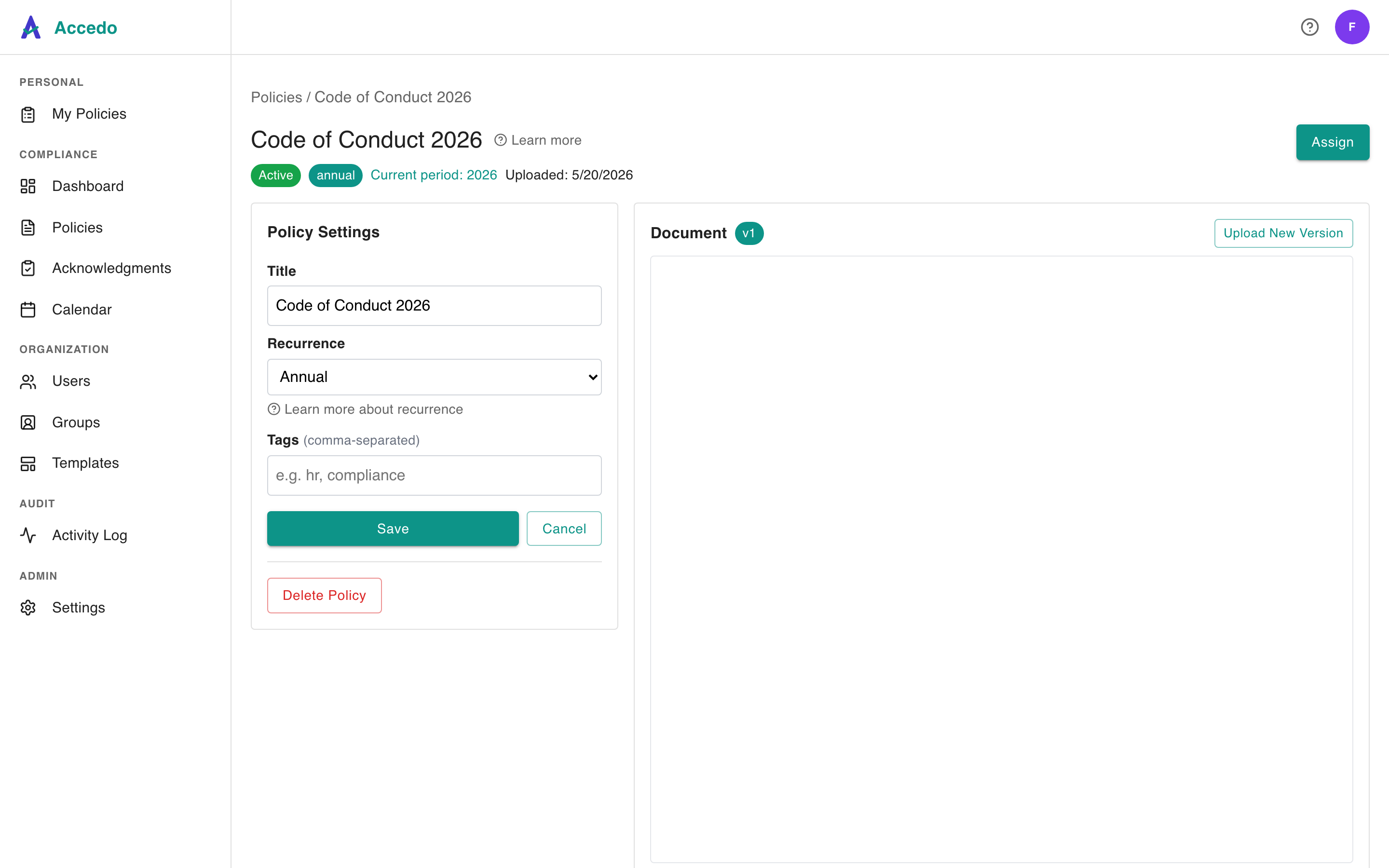
Where Accedo fits — the named-roster hook
Accedo does not write your Exposure Control Plan or your HazCom program, and it does not deliver hands-on training. What it does is produce, automatically, the named and dated record the Bloodborne Pathogens standard asks you to keep:
- Publish the plan — your Exposure Control Plan or HazCom program — as a policy, and auto-assign it to staff and groups so the right people are covered.
- Collect a dated signature from every signer, producing a per-person roster that names the attendee and records the date — exactly the shape of the 1910.1030(h)(2)(i)(D) record.
- Re-acknowledge annually so the team re-confirms the plan after each annual review or update.
- Export the audit trail — a timestamped record you can produce when an inspector asks for your training documentation.
The hands-on training still happens in your practice. Accedo makes the paperwork side — the named roster, the dates, the annual re-confirmation — something you can show in seconds rather than reconstruct under pressure.